Fragmented context.
The relevant information exists, but it may be in a different tool, file, or team when someone needs to decide.
Your work crosses boundaries.
Your tools should be able to follow.
ELQAVREN is developing a coordination layer for work across people, software, and machines—keeping context, permissions, boundaries, and evidence attached to the work.
 MANY SYSTEMS. A SHARED GOAL.
CONCEPT ILLUSTRATION
Eight downloadable operating systems with actual interior previews, exact contents, editable tools, and clear professional boundaries. Inspect the work before you pay.
Fourthwall handles secure checkout and immediate digital delivery. No physical item is shipped.
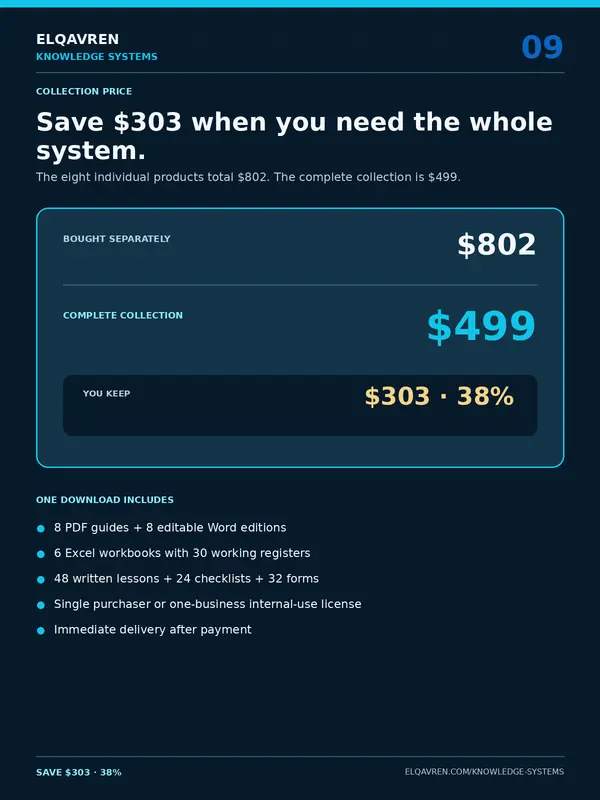 $802 separately. $499 together. →
When work crosses systems, the objective is only part of the problem. Context, authority, constraints, review, and evidence have to travel with it.
What is the person or organization trying to accomplish?
Which records, versions, and unknowns matter to the decision?
Who may access the information or authorize the proposed step?
What scope and operating limits must remain true?
What can be prepared for review within those limits?
What sources and observations would let someone check the outcome?
Who may accept, change, reject, or escalate the proposal?
These are parts of the proposed approach, not an automated execution sequence. Required authorization comes before action. A proposed step and an observed result remain separate.
Organizations already have tools that work. The handoff is where context gets rebuilt, authority becomes unclear, and the basis for a decision can disappear.
The relevant information exists, but it may be in a different tool, file, or team when someone needs to decide.
Access to information is not the same as permission to act on it. A copied instruction can lose its limits.
A result is difficult to assess when its sources, assumptions, and review history have become detached.
The goal is a shared workplace where you describe what you need to accomplish and ELQAVREN coordinates supported tools and machines. Connections and suitability must be established for each workflow.
Three questions should remain visible as a request moves toward a decision.
Keep access, approval, and the responsible identity explicit. An instruction does not create authority.
Keep the agreed scope and limits visible. A proposal does not authorize an external or physical change.
Keep sources, assumptions, missing information, and observations distinct so a person can evaluate the result.
Keep the right person responsible
for the right decision.
Start with a component comparison. Change the missing-information condition to explore where the illustrated review stops. Every record here is fictional.
You’re comparing a proposed component. Specifications, requirements, and unanswered questions sit in different places.
The intended approach brings that information into one comparison while keeping its sources and missing details visible.
Compare a proposed component against the stated requirements.
The intended application and the requirements the component would need to meet.
A component specification and a requirements record. These are illustrative source types, not uploaded files.
Published specifications are reference information; they do not establish fitment in the intended application.
A required component specification is missing. The comparison is incomplete.
Pause the comparison until the missing detail is obtained. No installation or physical change is authorized.
The person responsible for the technical decision reviews the evidence and decides what further checks are needed.
Keep the requirements, source references, assumptions, gap, and review basis together. An observed result would need separate evidence.
Less time reconstructing the comparison. A clearer basis for deciding what needs further review.
A missing fact is a reason to pause or narrow the review. The example does not invent an answer.
External action: none.Changing this example does not establish fitment, approve a component, or control equipment.
Software in development. This is a browser illustration, not a connected engineering tool. Benefits and suitability require evaluation.
The proposed first engagement is a paid, bounded evaluation of one workflow. Define what it may and may not do, then review compatibility, observed results, and remaining gaps.
Describe the workflow, systems, and people involved, and what a useful result would look like. Establish whether an evaluation is suitable.
Agree permitted records and access, the test environment, deliverables, effort, duration, price, and success criteria before work begins.
Review the evidence and gaps. Decide whether to stop, refine the work, or scope a separately agreed specialization or pilot.
The written scope would identify the deliverables: compatibility findings, an evidence and gap report, and a recommendation on whether to proceed. A bounded demonstrator may be included where the available interfaces, data, permissions, and capabilities support it. A finding that the proposed approach is unsuitable is a valid result.
ELQAVREN software is in development. Availability, technical readiness, scope, timing, and commercial terms for a specific evaluation need to be established individually. This page is an introduction to that conversation.
Prospective technical partners can describe the system, domain, or area of expertise they would like to discuss. More detailed technical information belongs in an agreed private discussion.
A short description is enough to begin a conversation. Scope and availability are agreed individually.
A draft for your email app.You review and send the message yourself to contact@elqavren.com. This website does not submit or store your inquiry.
An evaluation conversation does not assume deployment. Technical readiness and commercial terms need to be established for the specific work.
Sean McElroy founded ELQAVREN to develop an interface that keeps intent, permission, and evidence connected as work crosses systems.
Explore the merchandise collection. Options, orders, and checkout are handled by Fourthwall.
Visit the shopEnable JavaScript to browse the collection here.
Prices shown in USD. Shipping, taxes, and current availability are confirmed on Fourthwall before you pay.